


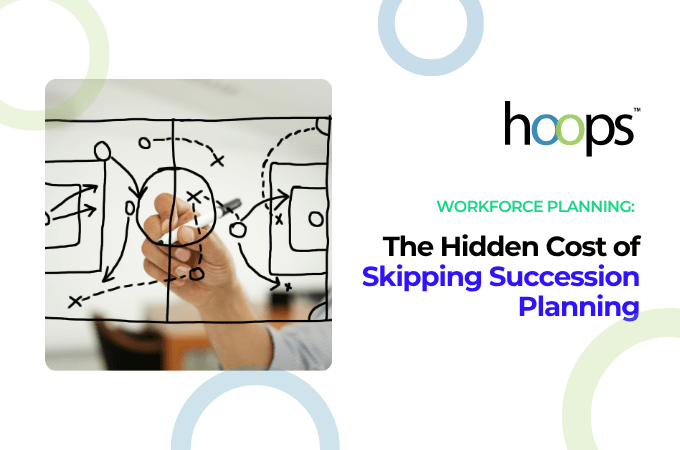
“Oh, succession planning. I don’t have time to do that.”
Mike Dixon, President and COO of Hoops, shares that this is the reaction he hears most when he brings the topic up with our C-Suite clients, right before he pushes back on it. “Sitting down and thinking strategically about the kinds of roles, not the people, but the kinds of roles you need to hire to grow your business is one of the single greatest long-term value creators you can put forth,” he said on The Automated Advantage podcast with Greg Clarke.
But if we’re being honest, most of us can relate to that same stance. Succession planning has a reputation for being some big, formal, and not to mention also expensive, enterprise-HR exercise. Something to get to when we have the money or time, or reserved for those large enterprise Googles of the world, and that’s just not us.
But that’s simply not true. If you have any plans to grow, having a simple succession plan in place is a must. No football team runs a season without a depth chart telling them who’s ready to step in if a starter goes down. How do you expect to 3x, 5x, 10x your revenue and size without some sort of people plan to get there?
For a growing company already stretched thin, it’s easy to file succession planning under “someday,” right next to the things that feel important but never quite urgent enough to land on the calendar. But if growing year over year matters to you (and it should), then having a plan to get there matters just as much.
The good news is it can be sometimes as simple as a few hours once a month, and you can start it yourself too. Nor do you need to hire expensive outside consultants to get results. To be fair, working with an outside partner like us isn’t free either, but it doesn’t have to feel as out of reach as bringing in a big-name consulting firm.
Give us the opportunity to share what it is, why you need it, and ways you can get started too, to make this finally a “today” thing.
What Succession Planning Actually Is (And Isn’t)
Before we get into the why, let’s clear something up. When people hear “succession planning,” a lot of them picture business owners planning who’ll take over or buy the company when they retire. That’s not wrong, and that matters too, but it’s not the full breadth, and it’s not what we’re talking about here.
What we mean is simpler and applies to companies of any size, at any stage: knowing which roles in your business would genuinely hurt operations, revenue, profit, and the like if they were empty tomorrow, and having a plan in place for what you’d do about it, whether that’s someone internal who could grow into it or a clear plan of what to look for externally. You don’t have to do it for every role (only your critical ones, which we’ll get to later), and you don’t have to have an exact successor for every seat forever. It all comes down to building some sort of starting plan and already having a head start on getting there. It’s an insurance policy on your growth, instead of being left scrambling with no backup plan should someone crucial leave, whether because they quit, retire, or otherwise (and there’s a 100% chance some turnover will occur, so might as well plan for it).
Therefore, this is not a big company exercise. This is for any company that has ever had a key person leave, which applies to most companies. Boiled down, succession planning is just knowing who steps in, or what you’d do, before that moment actually arrives, not after. If you want the bigger-picture view of how this fits into planning ahead more broadly, our blog on strategic workforce planning is a good companion read.
Most Companies Are Betting They’ll Never Have To Deal With This
Simple as that sounds, most companies still don’t do it. According to recent SHRM research, only 21% of organizations have a formal succession plan in place. Another 24% have something informal. The other 56%, more than half, have nothing at all. And when SHRM asked why, the top reason wasn’t indifference. It was a lack of time and resources to actually build one.
DDI’s 2025 HR Insights Report, based on responses from over 2,000 HR professionals, backs this up from another angle: only 49% of critical leadership roles could be filled internally today if they opened up right now. That’s basically a coin flip.
And that tracks, because succession planning has never really been systematized the way other parts of the business have. Nobody hands you a blueprint for it the way they do for building a house or launching a sales process. Without a repeatable, simple way to do it, “someday” is exactly where it stays.
The reality is that without one in place, companies are making a gamble whether they realize it or not: that a critical role won’t open up before they get around to planning for it. Sometimes they get lucky and someone’s ready and trained up to step in. But we can tell you firsthand, most of our clients come to us because that wasn’t the case, and they needed to “hire yesterday.”
And “hire yesterday” doesn’t just mean a longer search. It often means a harder and more expensive one, too as companies play catch-up to fill these critical roles.
Unplanned Hiring Is Harder, More Expensive Hiring
When you’re hiring under the gun, because you needed someone yesterday, you tend to make decisions you otherwise wouldn’t. You compromise on things you said were non-negotiable. You offer more than you planned to just to get someone to say yes. You skip a crucial round of vetting because you don’t have the luxury of time. None of that is a knock on you, it’s just what pressure does to decision-making.
And it adds up. SHRM’s own reporting puts the true cost of a bad hire, once you factor in recruiting, onboarding, lost productivity, and team disruption, as high as $240,000+ for some roles. That’s not a small number to gamble on because there was no plan in place before the seat opened up.
To be clear, this isn’t an argument against hiring externally. Plenty of the best people you’ll ever bring on will come from outside your walls, with experience and perspective you don’t have in-house yet. The argument is against hiring externally in a panic: no existing pipeline, no relationships already nurtured, and only a rough sense of what the role actually requires because nobody defined it ahead of time.
That’s exactly why succession planning still matters, even when the honest answer ends up being an external hire. Sometimes you go through the exercise and realize nobody internal is ready for a given role right now, and that’s fine because that’s still useful information. It just means the plan shifts: stay engaged with a trusted recruiting partner, and keep a warm list of past “silver medalist” candidates, the ones who were great but just not quite ready or the right fit a couple years ago, instead of letting that relationship go cold. Someone who wasn’t right for the role in 2024 might be exactly right for it in 2026, if you kept the door open.
Either way, the real difference isn’t whether you end up hiring internally or externally. It’s whether you’re doing it from a plan or from panic. A plan is what turns “harder and more expensive” hiring into faster and cheaper, whether the person who fills that seat has been in your building for five years or five minutes.
An Easier Path Than Panic Mode
On the Growth Shift Podcast with Jennifer Stile, Mike described what we’ve seen to be a much better way. “Great HR leaders are going to be able to go to their leadership before they go to market and say, according to our succession plan, looking at our critical roles, we need one of these kinds of leaders and we think we know where to find her.”
What a massive difference in response, all thanks to a simple plan in place. The panic version sounds like “oh no, what do I do, where do I even start.” The prepared version sounds like “hey guys, don’t worry, I know we pushed the emergency button, but I’ve got an exit plan here.” One is a company finding out a role is open and starting from zero. The other already knows the shape of what they need and has a real head start on filling it, internally or externally.
Here’s our recommended approach so you can DIY it and get started.
The 4-Step Succession Planning Process (In Brief)
Here’s the good news: this isn’t something you have to invent yourself. There’s a real, proven process behind it, one we’ve refined over years of working with organizations of all sizes and industries:
- Critical Roles and Experiences. Identify that critical 10-15% of roles, then get specific about what experience and knowledge someone actually needs to succeed in them. Our blog on identifying critical roles and our piece on A-roles and A-players are good read to getting a firm foundation to what critical roles are.
- Talent Review. A structured way to evaluate your current people against those critical roles, so you’re working from a real framework instead of a gut feeling about who’s ready.
- Succession Plan. For each critical role, get honest about who’s ready now, who’s ready in a couple of years, and where the honest answer is that you’d need to hire externally.
- Development Plans. For the people you’ve identified to succeed your critical roles, create a focused action plan to help close the gap between where they are and where the role needs them to be.
That’s the gist of it, and we’ve now published the follow-up: How to Build a Succession Plan That Gets Results (4-Step Process), which gets into the trenches on exactly how to run each of these steps yourself, including the actual framework we use for the talent review step. For now, the most important thing is just getting started.
Long-Term Value Doesn’t Come From Someday Projects
Succession planning is “one of the single greatest long-term value creators” a growing company can invest in. It’s not realistic to think it will prevent or immediately fix every disruption, but moving with a real plan in place will save you from hitting the panic button every time. And again, have we mentioned you’ll save both time and money (remember how expensive it is to get a hire wrong, not to mention the longer timeline of starting from scratch)?
To get started, you need to identify those 10-15% of critical roles. Even starting with just three to five roles now gets you ahead of the game, and you can keep building from there. A whiteboard, an honest hour with your leadership team, and a spot on next quarter’s calendar to revisit it and work on the next roles. That’s it.
At Hoops, this is the exact work our Talent Review Workshop does with clients, if you’d rather have someone professionally facilitate the process to make sure you’re seeing the best ROI. We run clients through a structured one-to-two-day session to identify critical roles, review your current talent against them, and build real succession and development plans, so the plan already exists before you need it. And we’ll do it at a rate you can actually afford, one that pays for itself in the cost savings and growth you’ll see across your business as a result.
👉 Schedule a free discovery call with Hoops
Build Your Winning Team. Hire and Scale Talent.