


Last week we made the case for succession planning: what it actually is, why most companies skip it, and what it costs you when you’re hiring in a panic instead of from a plan. If you missed it, read it here.
This week, we’re getting into the trenches of how to build a succession plan that works. This is our real, proven process our President and COO, Mike Dixon, refined over years working with organizations before bringing it to Hoops, broken into four stages you can actually run yourself.
Step 1: Critical Roles and Experiences
Start with the same 10-15% of roles we talked about last week, the ones that would genuinely hurt the business if they opened up unexpectedly. A critical role isn’t defined by title or seniority, it’s defined by impact: does this role have a direct, disproportionate effect on the business, and would it be genuinely difficult to replace the capability if it were vacant?
One example: we had a client where a diesel mechanic was identified as a critical role. Without this in-house position, trucks couldn’t get on the road, orders couldn’t be filled, and operations were halted. This wasn’t a senior-level position by any means, but it did mean lost revenue (and clients) if the position went unfilled for too long.
Once you’ve named those roles, go one level deeper: what experience and knowledge does someone actually need to succeed in each one? Not a generic list of skills, but the real, specific things a person needs to have done or learned to perform well. What would they need to have handled before to be ready? What knowledge would they need to acquire quickly if they didn’t already have it? This is the step most companies skip entirely, they know the role is important, but they’ve never actually written down what “ready for this role” looks like. This is similar to a job description, but one step beyond it, including things like key performance goals and skills readiness.
As you work through this step, our blog on identifying critical roles and our piece on identifying A-roles and A-players are worth a read through before moving on to the next step.
Step 2: The Talent Review (9-Box)
You may have already heard of this popular (and effective) exercise before, which we helped optimize for successful succession planning. A 9-box grid plots your people on two axes so you can see, at a glance, where your current team actually stands.
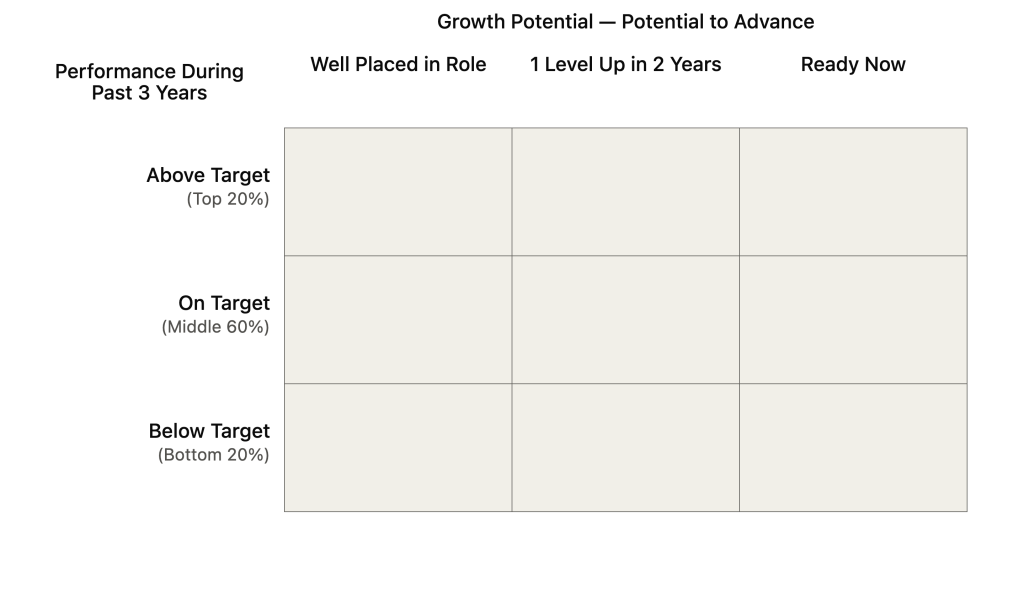
The performance axis (vertical) looks back at the last three years and sorts people into three bands: above target (roughly your top 20%), on target (the middle 60%, where most people land, and that’s normal), and below target (the bottom 20%). This isn’t about labeling people as good or bad, it’s about being honest that performance genuinely varies, and pretending everyone is equally strong doesn’t help you plan for anything.
The potential axis (horizontal) is about readiness to grow, not raw talent. Three categories: well placed in their current role (not necessarily a bad thing, some of your best people are exactly where they should be), one level up within about two years with the right development, or ready now for more responsibility today.
Cross those two axes and you get nine boxes. Someone strong on both performance and readiness is probably your best, and fastest, succession option. Someone strong on performance but not quite ready should clue you into building a real development plan to help them level up, in addition to allowing time. And if performance is the issue, that’s a coaching or PIP conversation before anything else, no matter where they land on potential.
A whiteboard and an honest conversation with your leadership team is enough to run this yourself. It’s also exactly the kind of exercise we help clients run well, so the right people end up in the right boxes and with the right plans in place.
Step 3: The Succession Plan
The 9-box tells you where people stand today. The succession plan is what you actually do with that information.
For each critical role, get specific about three things:
- Who’s the immediate replacement if the current person left tomorrow?
- Who’s ready now to step in with confidence?
- Who’s ready in about two years with the right development between now and then?
And for any role where the honest answer is nobody, that’s not a failure; it means the exercise is working! It tells you exactly where you need to build an external pipeline instead of assuming someone internal will magically be ready.
This is also where a plan earns its keep over time. It’s not a document you build once and file away. Review it at least once a year (ideally once a quarter), and any time a real business shift requires an updated plan for your critical roles.
Step Four: Development Plans
For every person you’ve identified as a successor, ready now or ready in two years, the plan isn’t complete until there’s a real path in place to get them where they need to go. An actionable plan you purposely guide them through that directly solves for: what experience do they need that they don’t have yet? Who owns making sure that happens? What would meaningfully move them closer to ready?
Back to that diesel mechanic example from Step One. Say the employee you flagged as a “level up in two years” still needs more experience on engine electrical systems, not just routine maintenance. Their development action might be as simple as shadowing on the next five electrical jobs that come through, and then eventually performing some fixes themselves, with their manager checking in after each one. Nothing fancy. Just something real and trackable.
None of this works without intentionality and accountability behind it. A development plan isn’t just a list of goals. It needs someone actually guiding the person through it, checking in regularly, and following up to make sure it’s happening, not just written down and forgotten. Also, this is something our Hoops team specializes in: building one-on-one, customized development plans that produce real results.
A Little Planning Goes a Long Way
You now have all four steps: know your critical roles, run the talent review, build the succession plan, and put a real development plan for your strongest potential employees. None of it requires special software or fancy tools to begin. It just takes an honest afternoon with your leadership team, a whiteboard, and a willingness to take the time to plan things out instead of assuming you’ll figure it out when the time comes (which gets you into panic mode and becomes expensive, and nobody wants that!).
You can absolutely do this on your own, and we hope this gives you a real head start. But if this is your first time running through it, or you’ve tried before and it didn’t get you the results you wanted, this is exactly where a trusted partner earns their keep. For instance, you can look up your own health symptoms online, but an experienced doctor still catches things a self-diagnosis misses, and knows what treatment actually works instead of taking guesses (and if we’re being honest, you can’t afford to guess in business). Same idea here: we catch the gaps you might not see, and make sure the plan you walk away with produces real ROI.
Our Talent Review Workshop walks you through all four steps with more depth, in a structured one-to-two-day session.
👉 Schedule a free discovery call to learn more
Build Your Winning Team. Hire and Scale Talent.